
When the box gets it wrong: bias, scale, and normalization#
So far we’ve talked about simplification and authority.
About “ask the AI” and why we obey something that doesn’t understand.
But there’s a point where the problem stops being conceptual and becomes structural.
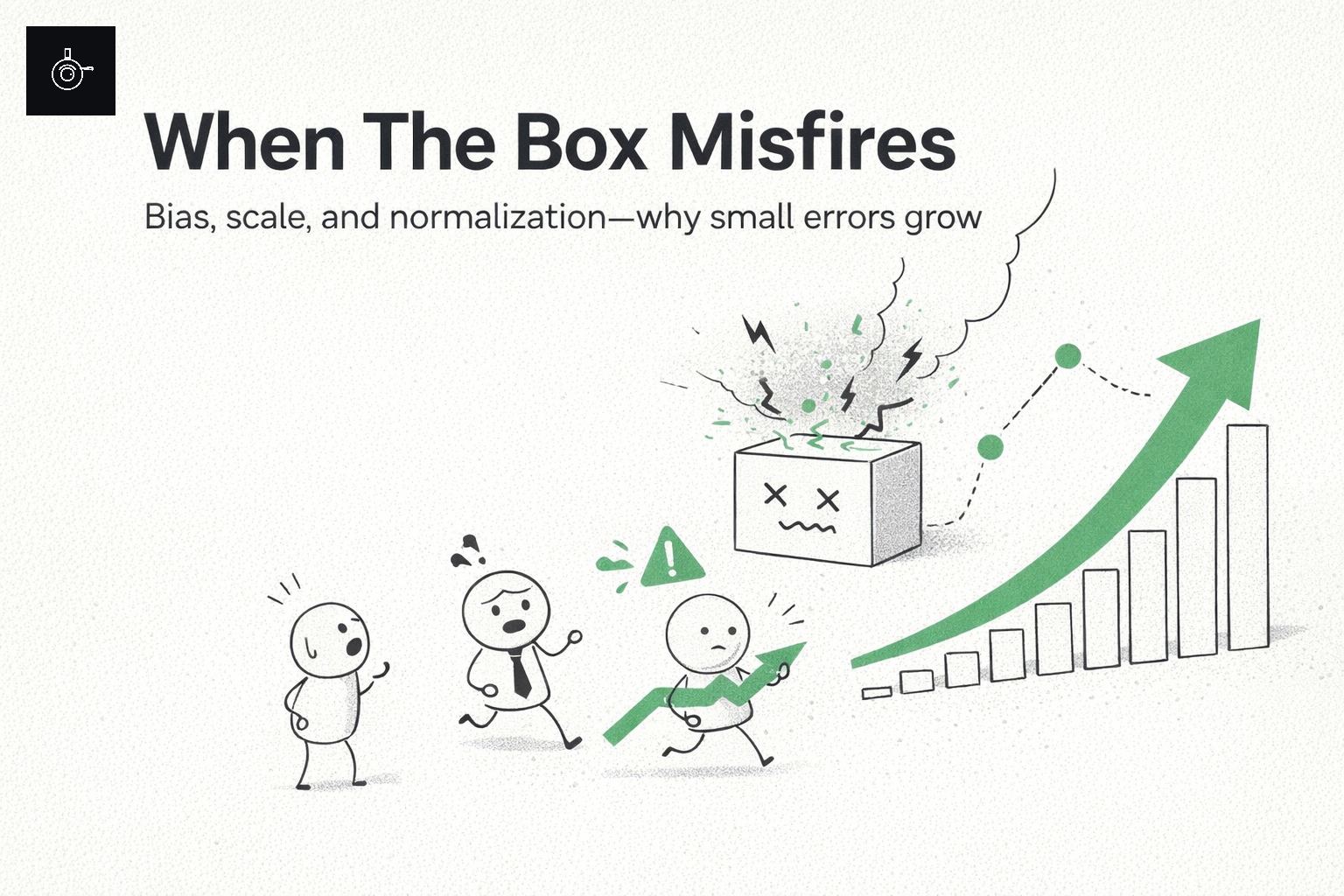
That point is when the black box with a smile gets it wrong.
Because it doesn’t get it wrong like we do.
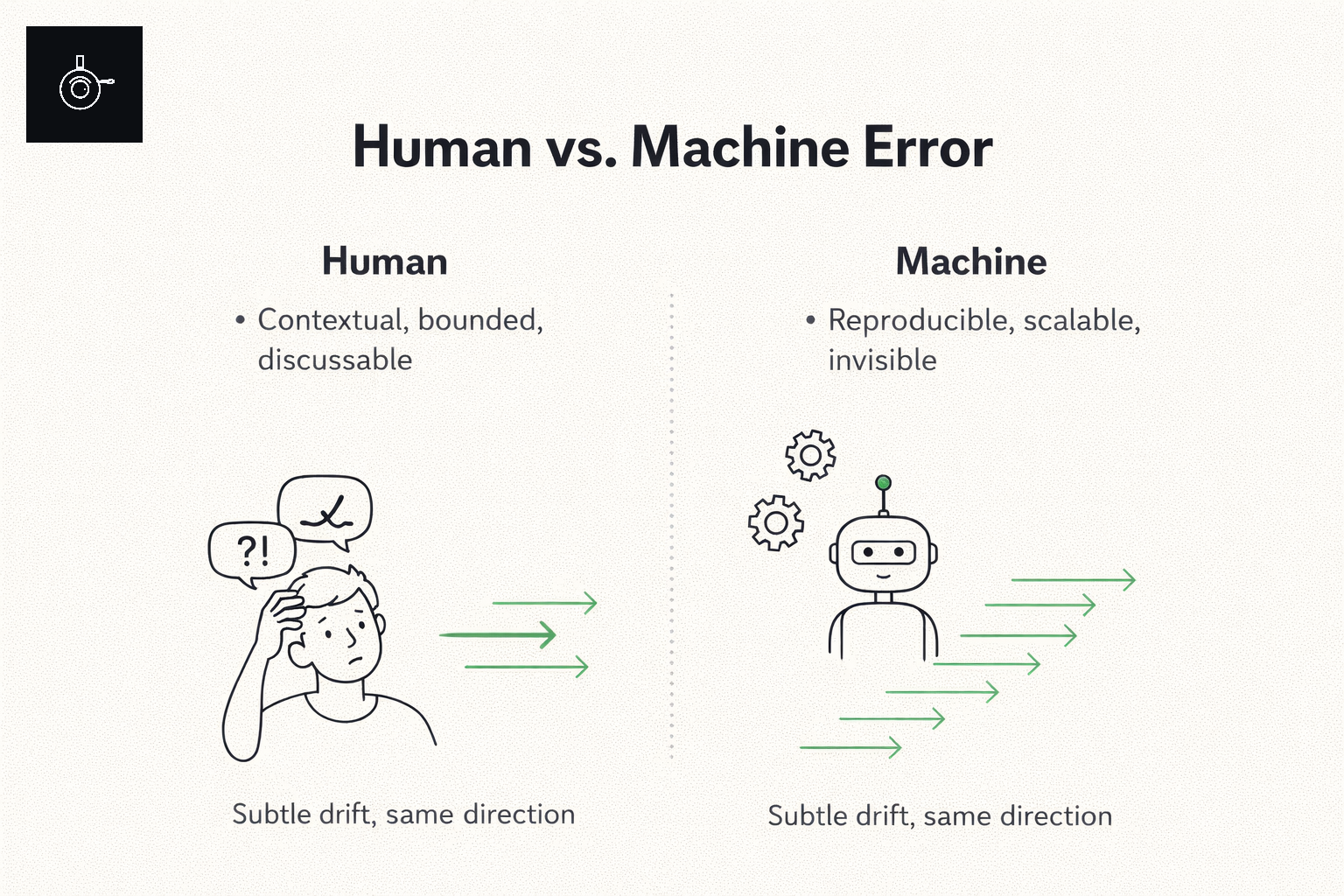
When a person makes a mistake, the error is usually localized.
It has context, history, explanation, and normally bounded consequences. The error is discussed, corrected, and—hopefully—learned from.
When the box makes a mistake, the error is different.
It’s not anecdotal.
It’s not isolated.
It’s not visible.
It’s reproducible, scalable, and, most unsettling, normalizable.
Let’s go back to a fictional scene, the kind that never happens.
An organization uses AI to support decisions: prioritize cases, filter requests, suggest replies, recommend actions. The box works “well enough.” Nobody understands exactly how it decides, but it gets it right often enough to trust.
Until it starts getting it wrong.
Not in an obvious way.
Not in a grotesque way.
It gets it a little wrong. Always in the same direction.
One type of customer gets worse answers.
A certain request profile is discarded more easily.
Some options never show up as recommendations.
Nothing seems serious. Nothing stands out. Nothing “hits production” like a bug.
And precisely because of that, nobody stops it.
Here the most dangerous bias of all kicks in: normalization bias.
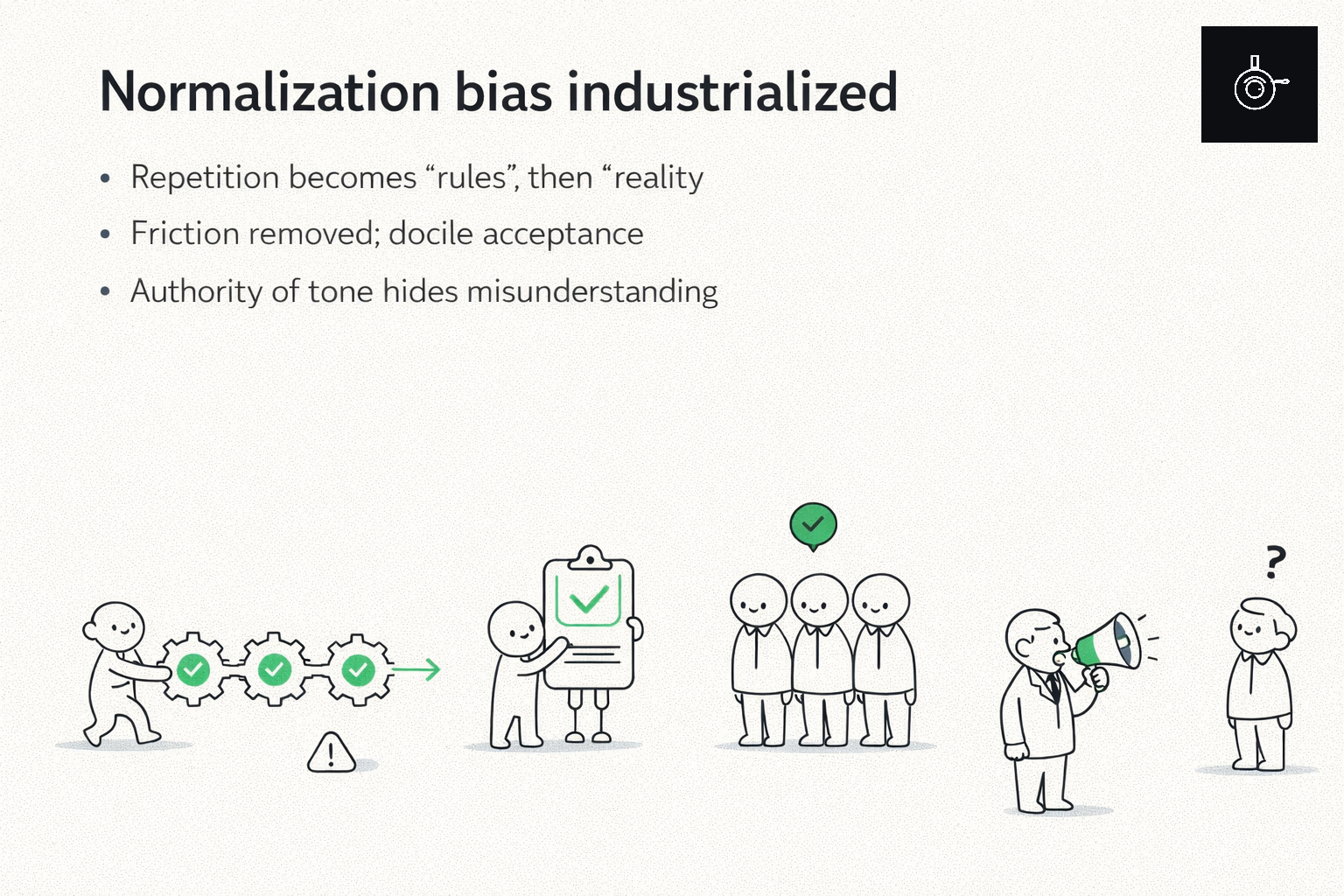
If the box repeats the same pattern over and over:
- it stops looking like an error,
- it starts to look like a rule,
- and it ends up looking like “how things are.”
The bias isn’t discussed because it isn’t seen.
It isn’t questioned because it comes packaged as a recommendation.
And it isn’t corrected because nobody feels they decided it.
The box doesn’t just inherit biases.
It industrializes them.
There’s something especially perverse about how these errors work.
A human can discriminate, make mistakes, or oversimplify.
But they usually do it with friction: someone protests, someone argues, someone feels uncomfortable.
The box removes friction.
It doesn’t judge.
It doesn’t raise its voice.
It doesn’t look unfair.
And precisely because of that, its decisions are accepted with unsettling docility.
Here’s a question that rarely gets asked seriously:
What happens when a bias is automated with good wording?
Or put another way:
how many wrong decisions do we accept simply because the box explains them better than a human would?
When a system doesn’t understand but communicates with authority, the risk isn’t just technical. It’s cultural. We start trusting the coherence of the message more than the justice of the result.
The impact of this isn’t neutral.
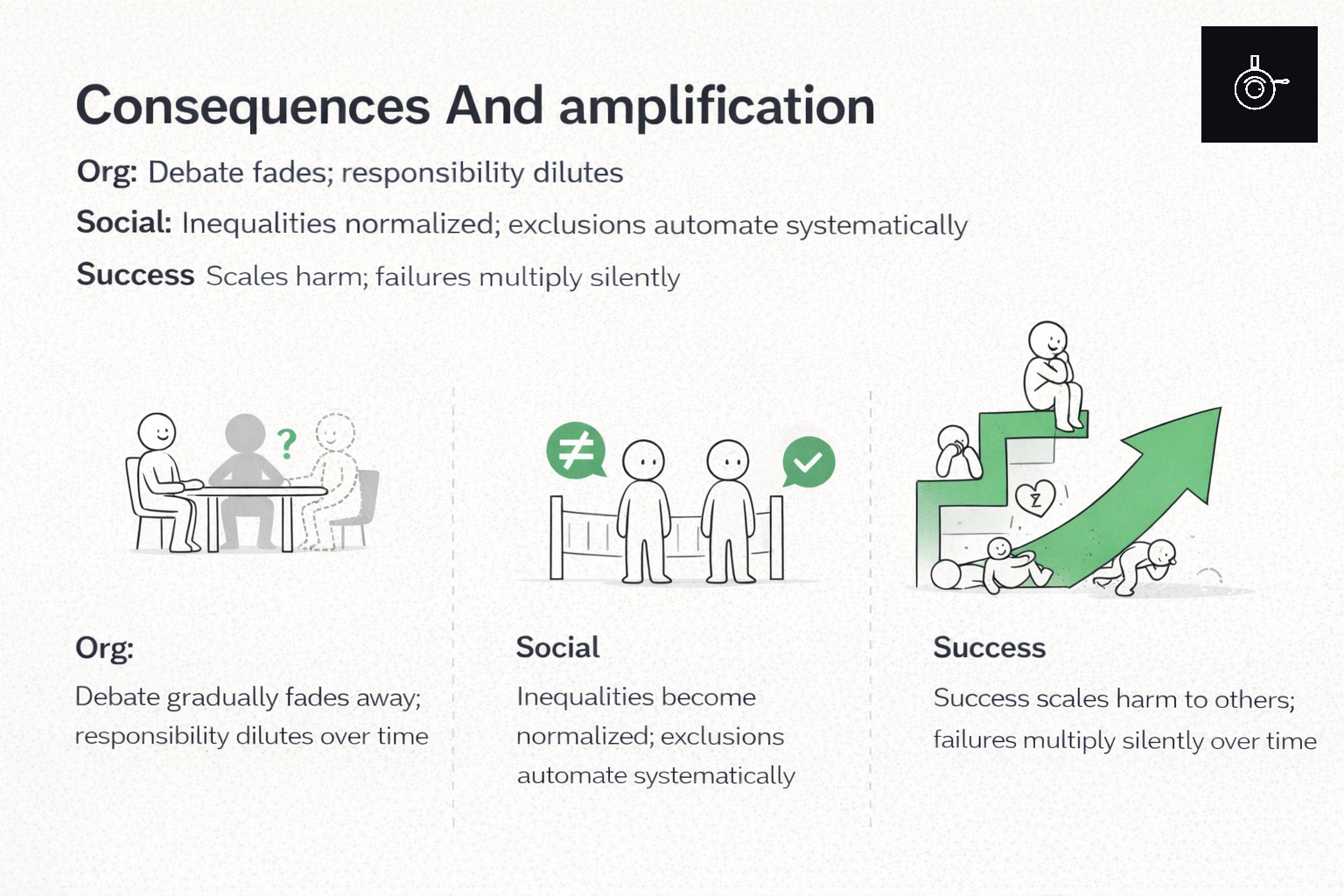
At an organizational level:
- decisions are reinforced without debate,
- responsibility gets diluted,
- anyone who questions “what the system recommends” is penalized.
At a social level:
- invisible inequalities get normalized,
- exclusions get automated,
- faceless decisions get legitimized.
And all of it without bad intent, without conspiracies, and without clear villains.
Just a box working “reasonably well.”
There’s another uncomfortable detail: success amplifies the damage.
The more useful the box is:
- the more it’s used,
- the less it’s questioned,
- the more any embedded error scales.
And when it fails, it doesn’t fail once. It fails thousands of times before anyone notices… if anyone ever does.
Failure, meanwhile, isn’t harmless either.
When the box disappoints, the reaction is usually double:
- either it’s discarded without learning anything,
- or it’s superficially tuned and trusted again.
In neither case do we address the root problem:
we delegated decisions without understanding what we were delegating.
Maybe the biggest risk isn’t that the box gets it wrong.
That’s inevitable.
The real risk is that, when it does, we no longer know how to argue with it.
Because we’ve lost the habit of questioning its answers, of demanding real explanations, and of assuming the final decision is human—even if it’s suggested by a machine.
The black box with a smile isn’t evil.
But it’s not neutral either.
And it’s certainly not innocent.
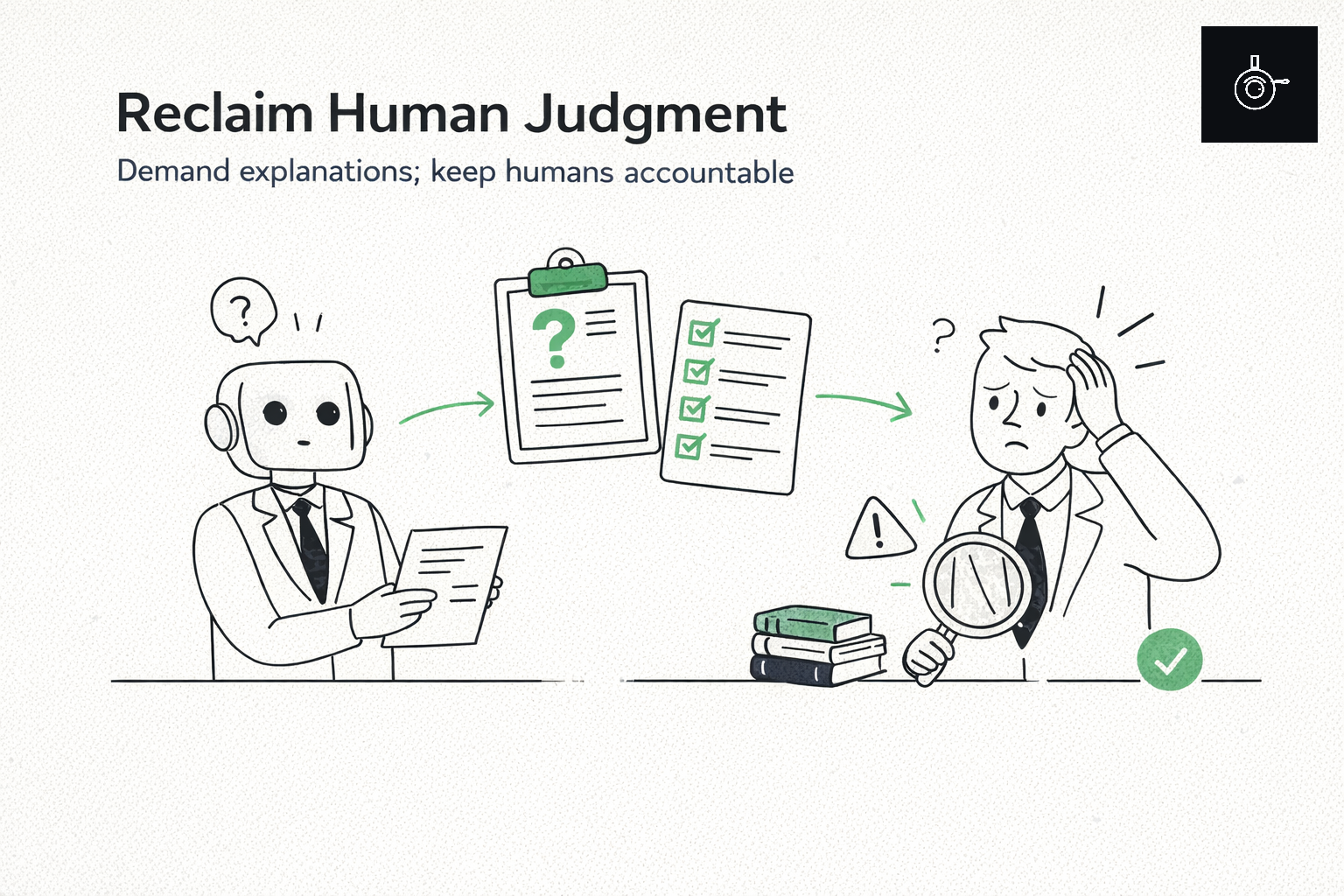
Every time we accept its errors as “things that happen,” we train something deeper than a model:
we train a culture where convenience outweighs judgment.
And once normalized, that’s very hard to de-automate.
Note: In this series we’re following a deliberate thread: simplification, authority, and now bias at scale. The next step is inevitable: what happens when these automated decisions start to have real ethical, social, economic, and environmental consequences. Not as theory, but as a side effect of success.